Pricing guide
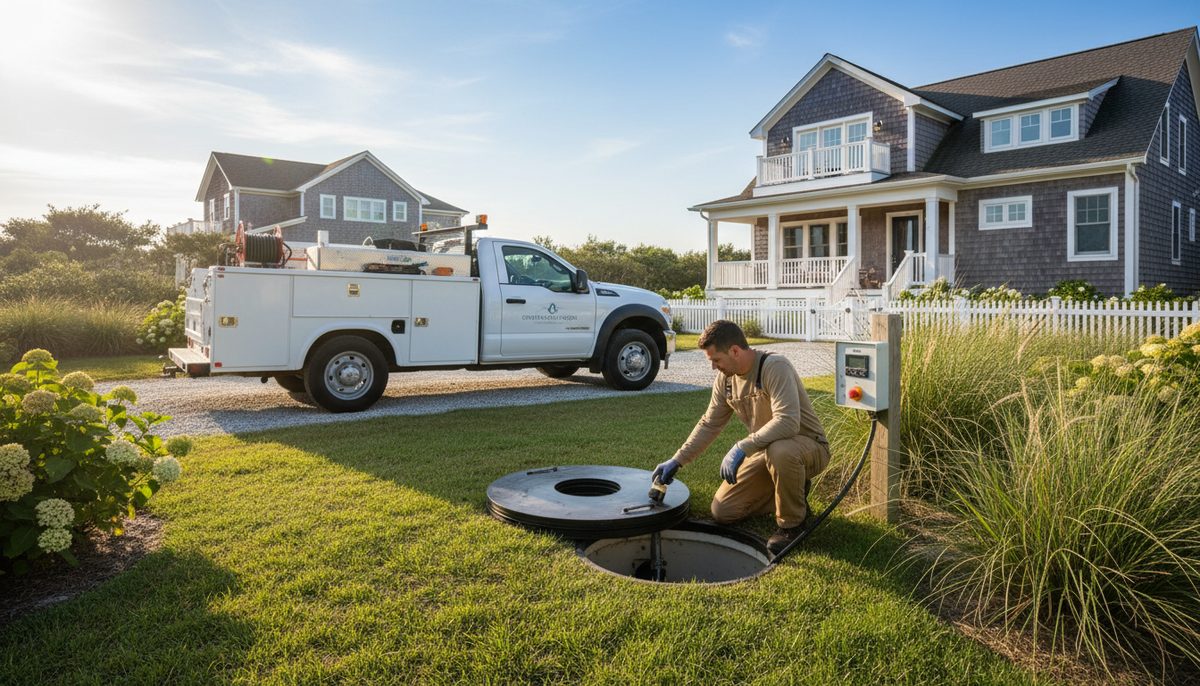
What a septic maintenance plan costs on the Outer Banks
What a septic maintenance plan costs on the Outer Banks: scheduled pumping at market rates, documented inspections, priority emergency response, and the math against one July backup.
Plans are priced honestly: the parts, plus the service
A maintenance plan is not a discount mystery — it is the same services a rental owner books anyway, scheduled instead of forgotten, with priority service attached. The parts are known quantities: a pump-out at the tank-size market rate (a typical 1,000-gallon tank prices in the $245 to $400 band in North Carolina, and coastal standard-tank work runs $250 to $500), the documented maintenance inspection that should ride along with it, and the record-keeping that turns both into paperwork a buyer or a rental manager can hold. A plan quote is those parts at their real prices, bundled into one predictable annual or biennial cost, discounted for the fact that we — not you — are carrying the calendar. What it never is: a low teaser number that excludes the inspection, the documentation, or the emergency tier.
The interval that sets the plan's price
How often the visits happen is the main price driver, and on the Outer Banks the honest answer is driven by occupancy, not by a generic chart. Coastal professionals commonly recommend pumping every 2 to 3 years, and the rental calendar pushes that toward the short end: a house that sleeps ten and turns over weekly from June to September loads a tank like nowhere else in the state. The plan sizes itself to the tank, the bedrooms — remember the state sizing standard of 120 gallons per day per bedroom — and the rental rhythm, which is why two identical houses on the same street can honestly need different plans.
What the plan fee buys beyond the visits
Three things separate a plan from a reminder app. First, priority emergency response: when a plan customer calls in July with a backup, that call goes to the front of the line — and in peak season the front of the line is the only place worth being. Second, the service history: every visit's written record stays on file with us, ready for a buyer's due-diligence packet, a rental management company's file, or an insurance question. Third, the coordination: visits land in the turnover gaps and shoulder weeks your rental calendar allows, arranged with the property manager rather than around them. None of those three appear on a per-visit invoice — that is exactly why they are in the plan.
The math that sells the plan (and it is not our math)
One mid-summer backup costs a Nags Head rental a week of bookings, a cleaning bill, a guest refund conversation, and an emergency service call — a total that clears any year of maintenance without breaking a sweat, before counting the reviews. Measured against a pump priced like a pump, in the $300 to $500 band most North Carolina homeowners pay, the plan is not a premium product; it is the same money spent deliberately instead of reactively. That is the whole pitch, and it is why almost every rental owner who runs one season on a plan renews it.
What a plan does not cover — said plainly
A plan covers scheduled pumping, documented inspection, records, and priority response. It does not cover repairs — a failed baffle or a dying drainfield is a repair project, quoted separately and priced by its scope — and it does not cover damage from things no maintenance schedule prevents, like storm surge flooding the system. An honest plan document says both of those on page one; ours does.
Starting mid-season, switching plans, and ending one
Plans do not wait for January. A rental that just took its first backup of the summer can start same-week: the first visit doubles as the baseline — layers measured, baffles checked, interval set from what the tank actually holds — and the emergency response that got you on the phone becomes the priority tier you now own. Owners who arrive from another company's plan owe us nothing but the tank's history: the last written record tells us what the previous schedule saw, and ours begins where that one stopped. And ending one is exactly what the paperwork implies — your records leave with you, complete and signed, ready for the next company, the next owner, or the closing attorney. The plan is the schedule and the paper; the system and its history are always yours.
Tell us the tank size, the bedrooms, and how the house is used — we will size the interval, quote the plan, and put the first baseline visit on the calendar.
On the record: every 2 to 3 years (Septic Tank Pumping Cost NC (2026), Septic & Well Pro) · $245 to $400 (Septic Tank Pumping Cost NC (2026), Septic & Well Pro) · $250 to $500 (Septic Tank Pumping Cost NC (2026), Septic & Well Pro)
Hand-verified 2026-09-17 against the primary sources named above; where a fact could not be verified it was left out, never guessed.